
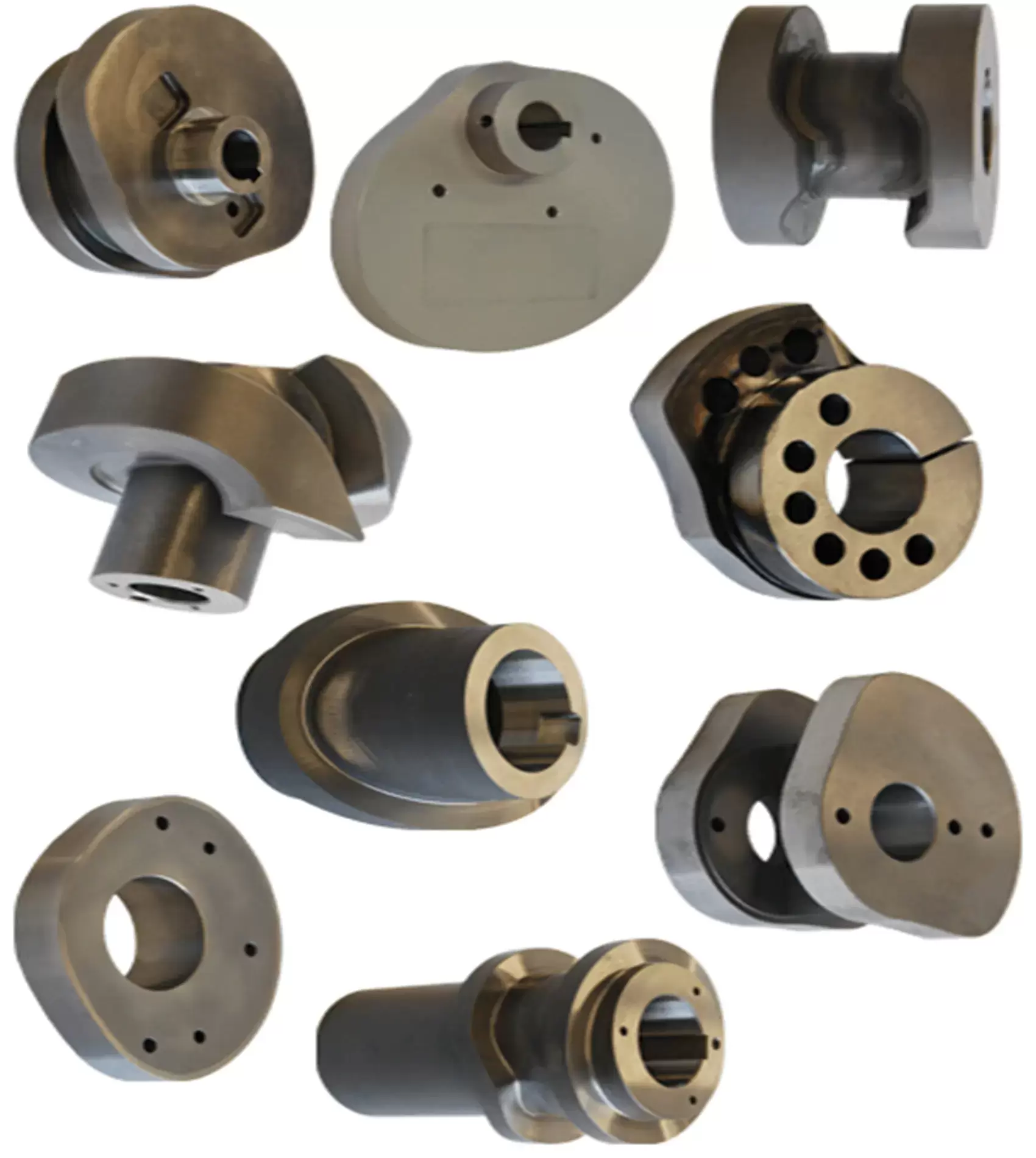
The manufacturing process of cast iron components involves several key steps to produce durable, versatile parts for various applications. Initially, the selected raw materials, typically iron ore, coke, limestone, are melted in a furnace at high temperatures to form molten iron. Once the molten iron is obtained, it is poured into molds, often made of sand or metal, in the desired shape of the component. During solidification, the molten iron fills the intricate details of the mold, forming the final shape of the component. After cooling, solidification, the cast iron component is removed from the mold, trimmed, subjected to finishing processes such as machining, grinding, surface treatment to achieve the required dimensional accuracy, surface finish, mechanical properties.
Cast iron components offer exceptional durability, heat retention, and machinability, making them ideal for a wide range of industrial applications.
Cast iron components possess inherent corrosion resistance due to the formation of a protective oxide layer on their surface. This makes them suitable for applications exposed to corrosive environments, such as water pipelines and marine structures.
External coatings or surface treatments, such as epoxy coatings or galvanization, can further enhance the corrosion resistance of cast iron components, extending their service life in aggressive environments.
Its microstructure, typically comprising graphite flakes in a matrix of ferrite or pearlite, provides excellent resistance to wear and abrasion, ensuring prolonged service life even in harsh operating conditions.
Cast iron exhibits good thermal conductivity and heat retention properties, making it suitable for applications involving high temperatures, such as engine blocks, exhaust manifolds, and industrial furnaces.
Its low coefficient of thermal expansion minimizes distortion and dimensional changes at elevated temperatures, ensuring dimensional stability and reliability in thermal cycling environments.
External coatings or surface treatments, such as epoxy coatings or galvanization, can further enhance the corrosion resistance of cast iron components, extending their service life in aggressive environments.

Cast iron components exhibit exceptional mechanical properties, making them suitable for a wide range of applications. Their high compressive strength, coupled with good wear resistance, allows them to withstand heavy loads and abrasive environments. This makes cast iron components ideal for applications such as engine blocks.

Cast iron's inherent properties, including its low melting point and excellent fluidity during casting, contribute to its superior machinability. This enables intricate shapes and complex geometries to be achieved with precision, making it a preferred choice for components requiring tight tolerances.

Cast iron components demonstrate good corrosion resistance, particularly when subjected to environments with high levels of moisture or chemical exposure. Surface treatments such as painting or coating can further enhance their resistance to corrosion, extending their service life in harsh conditions.